Evermotion Challange: Summer in The City
2014
Client
Evermotion
The Challange
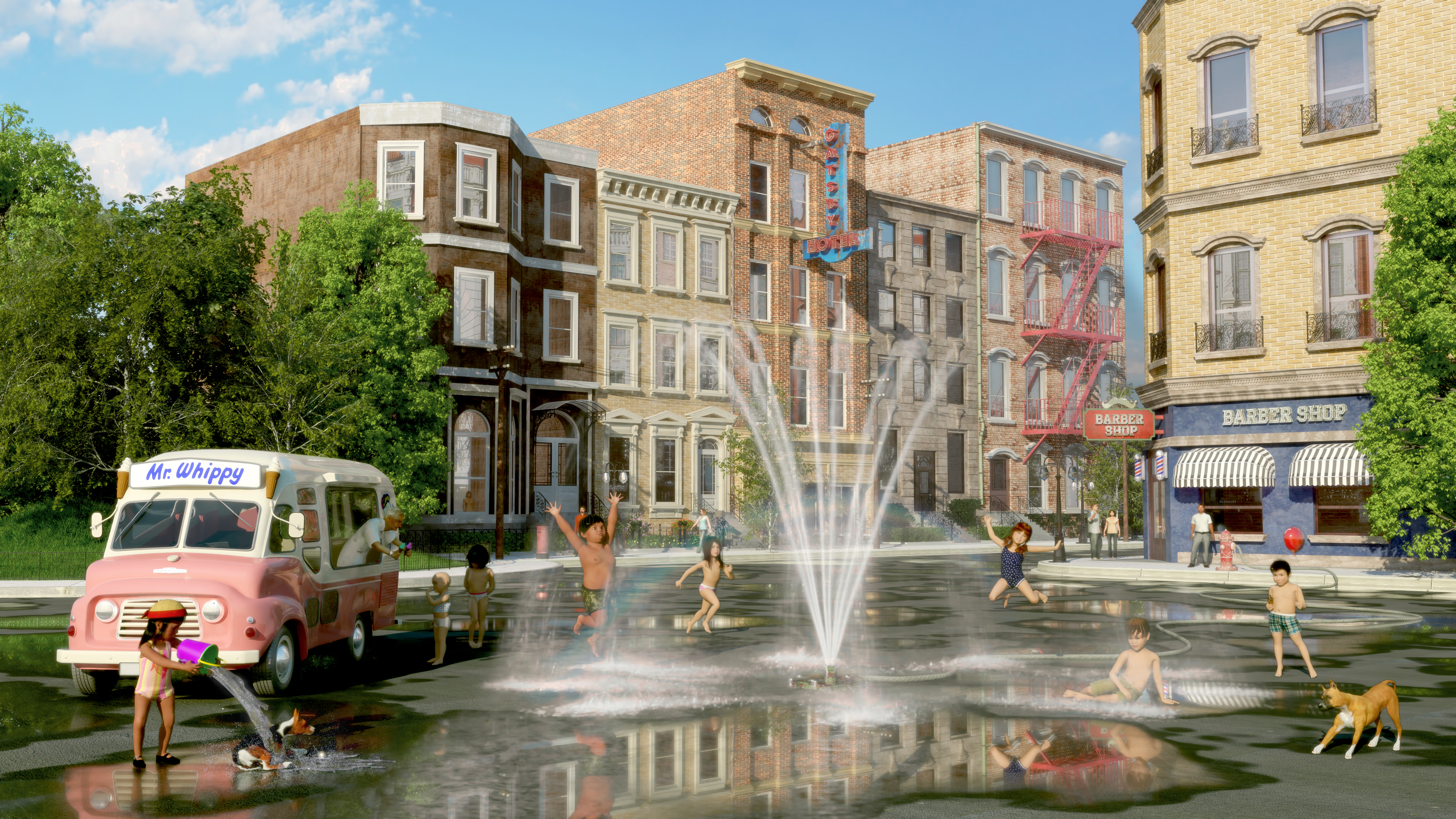
This project was a technical and creative challenge focused on building a believable, story-driven summer scene entirely in 3D. The goal was to recreate the energy of a city heatwave children playing with water, dynamic splashes, reflective surfaces, and a dense urban environment—while maintaining realism, scale consistency, and visual clarity.
The main challenges involved managing complex simulations (water interaction, splashes, and wet surfaces), coordinating multiple animated characters, and achieving physically accurate lighting and reflections across a large outdoor scene. Special attention was given to storytelling through composition, mood, and environmental details, inspired by historical summer street scenes.
From modeling and simulation to lighting, texturing, and final compositing, the project required a production ready pipeline and careful optimization to keep everything cohesive, readable, and emotionally engaging.

The Concept
The concept is inspired by the idea of summer in New York as a shared urban ritual a moment where the city slows down and public space becomes a playground. Long before air conditioning and digital entertainment, the streets themselves were places of escape from the heat.
Children running through water hydrants, improvised pools on the sidewalks, ice cream trucks parked at the corner, and entire neighborhoods gathering around simple moments of relief and joy. These scenes represent a raw, collective energy that defines the city’s summer identity.
The goal was to translate this historical and emotional reference into a contemporary 3D scene, capturing not just the architecture of New York, but its social rhythm, density, and spontaneity. Water acts as a central narrative element reflecting the city, amplifying movement, and connecting characters, space, and atmosphere into a single moment frozen in time.


Pipeline & Workflow
The project was developed using a production-oriented CG pipeline, designed to handle high scene complexity while maintaining flexibility for creative iteration.
The workflow began with environment blockout and asset planning, establishing scale, camera language, and composition early on. Modular architecture and reusable assets were prioritized to keep the scene scalable and consistent.
AI-assisted workflows were integrated during concept validation, reference analysis, and look development, allowing rapid exploration of visual directions before committing to heavy simulations or detailed shading. This reduced iteration time and helped guide artistic decisions with greater confidence.
Character setup, animation, and water simulations were developed in parallel, with continuous testing to ensure interaction accuracy between characters, splashes, wet surfaces, and reflections. Simulations were iterated incrementally to balance realism, control, and performance.
Lighting and texturing focused on physically plausible materials and natural daylight behavior, emphasizing reflections, translucency, and surface response to water. Final compositing was used not as a fix, but as a refinement stage enhancing depth, contrast, and atmosphere while preserving the integrity of the render.
Overall, the workflow reflects a 3D Lead mindset, where AI tools function as accelerators inside a solid production pipeline, enabling faster iteration, clearer creative direction, and production-ready results.